
WTF Cambodia? Q&As I’ve considered as I learned about Cambodia’s genocide
- Liz Harrison

- Aug 11, 2016
- 7 min read


There’s been a long list of things I’ve been working to wrap my mind around as I’ve traveled this summer; everywhere I’ve been has its own history and way of doing things, and the collective consciousnesses of these countries have taken work to unravel. Cambodia is the most contradictory place yet, and the more I’ve learned the more crazy this place seems.
Once upon a time, the people living here farmed, built magnificent wonder-of-the-world type stuff (Angor Wat in 2 days!), and were progressing along nicely towards (I’m assuming) prosperity while building their identity in the global arena. Then one of their best and brightest went away to school in France, and came back as a soon-to-be tyrannical despot disguised as a liberalist teacher. I can’t deny that I made a quick mental comparison between this history and our current drama teacher come Canadian Prime Minister, and my own political and professional identity quavered a bit as I thought about the way Pol Pot’s regime had been established.


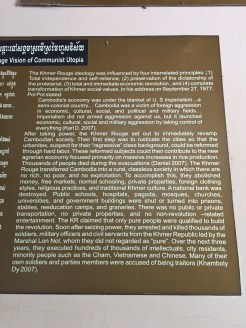

How to be a Dictator: Pol Pot Edition
Step 1: Disguise self as shaper of young minds, wise learned person, and lefty supporting equal treatment and sharing is caring communism.
Step 2: Divide and conquer with flash deurbanization by telling people in the city with soft hands and glasses that more poorly aimed Vietnam bombs are on their way. Detain anyone with more education than high school, fluency in other languages, religious leadership charisma/ sway, and the aforementioned soft hands or glasses.
Step 3: Brainwash high school aged boys (mostly) with slogans like “Clearing grasses, it shall take its entire root off.” so they know to exterminate family members of all ages, then give them power and some weaponry along with a sense of purpose and fear for their own lives.
Step 4: Have teen-aged army torture, maim, kill 3 million of your countrymen (without wasting bullets), legitimize slaughter with forced “treasonous confessions”, and keep everything a secret by participating UN activities and presenting a face of coherent governance to the world.

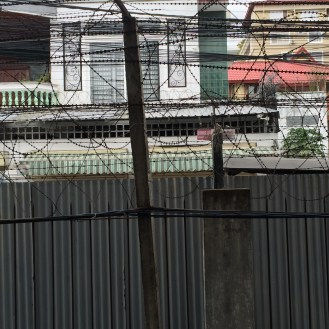


Photos taken by the author during her visit to the Tuol Sleng Genocide Museum in Phnom Penh, Cambodia. The museum was previously a high school, then become Security Prison 21 (S-21) by the Khmer Rouge during their rise to power.
My biggest as-yet unanswered question: Why let Pol Pot live to 73?! Once people realized what he did, you’d think a few people at least would have been out for revenge? The rest I think I’ve muddled through, although my understanding is essentially based on today (filter, possible but unlikely national/ historical propaganda), primarily western and spotty at best understanding of historical scope, developing sense of global historical arcs. Truth and reconciliatory justice practices seem to have led to this level of self-examination and reflection for Cambodians at the preserved historical sites like this museum and the Killing Fields. I’m sure there are many aspects and contexts of which I am unaware, and which may still continue to play out today with the ongoing struggle of poverty here.
Q. Why keep the monarchy? Were these guys even around during this whole thing? Did they turn a blind eye to save their own skin? If so, why celebrate and continue to support that kind of leadership? If not, why trust anyone with that kind of power again? I don’t have a good understanding of this history, but I don’t get it either way. Plus, what do those guys even do now?
A. I could answer this better with research, but honestly I’m sceptical of finding truth even with that. There tends to be a strong skewing for the “optics”, and if my visit to the royal palace this morning is any indication, there’s bound to be a lot of visitor paths and cordons preventing further venturing. I’m assuming this would come down to something like the devil we know, or thank goodness someone knows how to drive this bus of a country. Maybe there’s enough separation between the military coup and the state leadership, or maybe there’s not enough separation between church and state, and you end up keeping the guy who says god picked him for the job.
Q. Why not be more suspicious? I get that this guy Pol Pot and “his” men (who were once your brothers and sons, pre-brainwashing by crazy dictator, and were scarcely old enough to shave) killed off all the educated people and were all about returning to the “old ways”, but weren’t you just a little suspicious about his motivations for doing that? I cannot imagine that rural folk were excited about abandoning their farming tools to rust or ignoring recent agricultural innovations while trying to suddenly produce three times the crops. I feel like at least a few people should have been like, “Hey, you know, that guy killed off all those book smart guys, you think maybe we need some new ones?” Or “Man I wish someone could speak Vietnamese! They’re right next door, they might have some help to offer!”
A: I’m sure in my short years of teaching, I’ve had a few students wish for my demise (although only one actually comes to mind, and I’m pretty sure even she wouldn’t REALLY want that, although it’s unlikely shed shed any tears if it did). I can at the very least understand the idea of celebrating the elimination of formal schooling. Some kids are still kids, but want to get out into the workforce, become a bona-fide adult with a job and everything. The realities though generally have students thinking wistfully of the days before bills and responsibility in a matter of years. Pol Pot returned to Cambodia and began teaching, after being educated abroad in France. The Genocide Museum is actually housed in high school that had been used for torture during his regime. (Could it have been where he himself once taught? Another question…) He probably identified his biggest competition and started targeting them to remove major obstacles in the path of his continuing extermination. Teachers, people who spoke another language (can you go to school in France and not need to learn French? Unlikely), educated professionals with soft hands or glasses, whose knowledge was a greater threat than potential asset. Exceptions I remember from the museum were men who could paint and thread a typewriter; artists to record his victor’s history. Take them out to keep dangerous ideas from spreading, control the flow of information and educate your teens with your personally crafted filter. And who’s going to be around to tell them what they don’t know that they don’t know?
Q. Why now idolize America? Their entertainment, their almighty dollar, their fast food chains (seriously, there’s a Krispy Kreme 30ft from my hostel in Phnom Penh)… What exactly do you believe you are aspiring to here? Might want to double check, you may have been misinformed about capitalism…?
A. As national, patriotic models go, the US certainly seems to own the spotlight. Or so it is suggested, in media presence, entertainment volume, global dominance, the US dollar. Maybe the right wing capitalism was most appealing following devastation of a communist “government” and the supposed efforts for the greater good that cost so much and killed so many. It must feel like rebellion and revolution to shift ideals so dramatically. It’s easy to miss or overlook some of the flaws (inherent in every system that I know of, more so in the wrong hands). It must be appealing, after the crushing responsibilities of caring for land and neighbour before self that Khmer Rouge communism required, when capitalism says you can look out for number one all the way to the bank.
Q. And the question most closely linked to my own experiences here: Why the thinly veiled hate? Why the passive aggression with us foreigners? I know tourists are irritating in some ways, but aren’t we bringing in some good cash flow too? (And paying somewhat exorbitant prices compared to your neighbours, and in US dollars no less?)
A. Tourists are annoying, I know. A necessary and generally beneficial evil, there are problems that come with cash. They’re like helping a very drunk acquaintance sometimes: you don’t want to see them hurt, but also aren’t completely invested*, since their state is a result of their own choosing, and they should’ve known better**. I, for example, shield be listened at my hostel this morning and just booked a driver for the day. I (stupidly) though booking a tuk tuk from location to location would be better and cheaper, since I didn’t want a tour guide or schedule. It wasn’t, I’m an idiot. I luckily got a very nice driver who I asked to contract with me for several stops once I was in the middle of nowhere at the Killing Fields. I paid $32US instead of $25, and would’ve spent more if I hadn’t been so worn out by the emotionally-heavy content of the day (I skipped an afternoon at the Russian market, the silver pagoda, and another museum that day in favour of a nap).
The thing I think would be most frustrating here with developed-world tourists would be the envy. I’m envious of the better-traveled people I’ve been lucky to meet – they have had adventures and gained life experiences that I covet in some ways for sure. Tourists also have privilege, the ability to travel, have been able to take the time, a job they can leave or return to or get, income that can be spent on all of these frivolities. Maybe even a passport they can access more countries with than they understand or appreciate.
So there. I’ve answered my own questions, which was actually not the way I started this post at all. I thought I was going to rant it out, now I can’t remember what I was annoyed or frustrated by exactly. My second day in Chiang Mai, Thailand, a girl who was two days into her new job at the cooking class I attended asked me in the van on our way there in the morning: “What do you like about your country?” I said something about the trees and mountains I think, but her question has stayed with me; I’ve definitely gathered a long and growing list of much better answers about Canada as I travel beyond its borders.
*Depending on your industry, locale, etc – ranging scale of closeness works here. ** Done more (or any) research, planned better, paid more for the appropriate level of support and guidance needed.

Comments